
The Iboga Plant and the Bwiti People Who Carry It
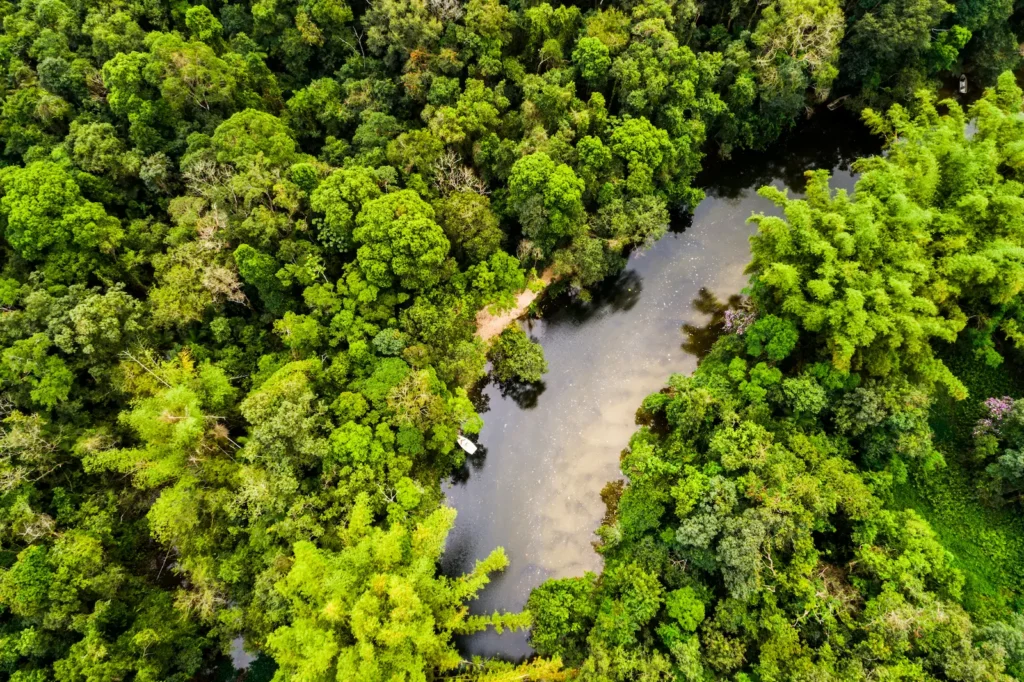
Long before iboga was spoken of in clinics or studied in laboratories, it was known as a teacher. It grew in the shaded understory of Central Africa’s equatorial forests, and the people who lived among those trees came to regard its root not as a drug but as a doorway. To understand iboga, you have to begin where it begins: in the soil of Gabon, and in the hands of the people who have carried its wisdom across generations.
A plant of the deep forest
Iboga is the common name for Tabernanthe iboga, an evergreen shrub in the Apocynaceae family. It is native to the rainforests of West-Central Africa — most abundantly Gabon, but also Cameroon, the Republic of the Congo, the Democratic Republic of the Congo, and reaching toward Angola. In the wild it grows as a branching shrub, usually a couple of meters tall, though in ideal conditions it can rise into a small tree. It bears narrow dark-green leaves, clusters of tubular yellowish-to-pink flowers, and small orange fruits.
The plant’s power lives underground. Its root bark concentrates a family of indole alkaloids, the most significant of which is ibogaine. These compounds are why iboga has been revered for its visionary effects and, in modern times, studied for its neurological ones. The fruit, by contrast, carries none of this potency — it is the root that the tradition reaches for.
Iboga is also particular. It asks for warmth, deep humidity, rich shaded soil, and the specific ecology of the rainforest floor. This is part of why it cannot simply be transplanted anywhere; it is bound to its place, and to the forest that has always held it.
The Bwiti: keepers of the medicine
In Gabon, iboga is inseparable from Bwiti — a spiritual tradition often described by its own practitioners as a “school of life” rather than a religion in the Western sense. Bwiti weaves together animism, reverence for ancestors, a profound relationship with the forest, and in some lineages, later elements of Christian liturgy. It is recognized as one of Gabon’s official spiritual traditions.
The roots of Bwiti reach back to the Babongo people, among the oldest forest-dwelling communities of the region, who are widely credited with first discovering iboga and its uses. (The older colonial-era term for these communities is now considered derogatory.) Over time the knowledge was shared with neighboring peoples — the Mitsogo, the Punu, and the Fang among them — each of whom developed their own expressions of the practice.
At the heart of Bwiti is the initiation: a rite of passage in which a person takes iboga for the first time, often over the course of several days. Ceremonies are led by a spiritual elder — the N’ganga — whose knowledge of the medicine, the songs, and the unseen world guides the journey. Music is not decoration here but a vehicle: drums, rattles, the sacred mouth-bow, and repetitive melody carry initiates through the long hours of the night. Through this, practitioners describe meeting their ancestors, confronting their own depths, and returning with insight they carry for the rest of their lives.
A tradition that survived
Bwiti has not had an easy passage through history. Under French colonial rule, the tradition and its practitioners faced suppression, and the communities who held iboga at times withdrew it to protect both the medicine and themselves. That it endures at all is a testament to the resilience of the people who refused to let it be erased.
Honoring the source
Today iboga sits at a crossroads. As interest in the plant has spread across the world, demand has placed real pressure on wild populations. While the IUCN has not classified Tabernanthe iboga as endangered, conservationists and Gabonese communities have raised serious concern about overharvesting and poaching of wild plants to feed an export market.
Gabon has responded. In 2000 the government declared iboga part of the nation’s cultural heritage. In 2019 it suspended the export of wild-harvested iboga, permitting export only of cultivated plant material meeting strict requirements. Gabon was also the first country to ratify the Nagoya Protocol — an international framework designed to ensure that when a community’s traditional plant knowledge is used, that community shares fairly in the benefits.
Organizations such as Blessings of the Forest now work directly with Gabonese villages to build a fair-trade iboga model rooted in the Nagoya principles of reciprocity, sustainability, and consent. Their concern is blunt: without these protections, iboga risks becoming what one advocate called the “blood diamond” of the psychedelic world — a sacred plant extracted from its homeland while the people who protected it for centuries are left out.
To honor iboga, then, is not an abstraction. It means asking where a plant came from, whether the lineage that carries it was respected, and whether benefit flowed back to the forest and the communities who have always been its keepers. The plant and the people cannot be separated. To receive one is to take on responsibility to the other.
Sources
- Tabernanthe iboga — Kew Science, Plants of the World Online
- Tabernanthe iboga — Wikipedia
- Pope, H.G. (1969), Tabernanthe iboga: an African narcotic plant of social importance, Economic Botany — Springer
- Bwiti — Wikipedia
- Bwiti rituals — 101 Last Tribes
- Missoko Bwiti Tradition — Root Healing
- Iboga: Basic Info — ICEERS
- The Promise of Nagoya — Georgetown Journal of International Law
- The psychoactive drug ibogaine could save lives — National Geographic
- Conservation & Iboga (Nagoya) — Blessings of the Forest